Thoughts on AGI and Creating for Learning and Entertainment
If you define AGI as an artificial intelligence that can do most tasks better than most humans, then I think we crossed this sometime between January and June 2026. Of course this is limited to digital tasks. But if I think of any task that can be done on a computer, I believe we’ve crossed that line.
I’ve experienced this at work because I’ve observed agents being able to do more and more sophisticated work and work for longer periods of time.
I’ve experienced this personally by attempting to create different web tools, videos or even 3-D animations recently. Each time I’m able to literally just create what I had wanted and it’s often better than I expected.
I created a web app to track different definitions of AGI and see if we’ve met any definitions yet. First, the fact that Claude Code + Opus 5.5 could do the research, create this application for me and then deploy it is unreal. I would not have attempted this type of project pre-2023. I’d have these questions but those questions would just lie around in my Todoist. Going back to definitions of AGI, only one definition, Peter Norvig et al.’s, has been met:
“The standard is breadth, not reliability or expertise. The frontier models of 2023 already qualified, and today’s models qualify more clearly. It is the only definition fully met, because it asks the least.”
That, in my estimation, is a little early. The frontier model of 2023 was GPT-4 and there were no coding harnesses like Claude Code or Codex yet. Yes, the frontier models of 2023 could answer many questions; however, they were limited in how much actual work they could do in actual systems. Now in September 2026, with the increase in model intelligence, improvements in model harnesses and the types of tools available, the range of tasks agents can do has exploded. I think that’s why you see an explosion of assistants ever since OpenClaw in December 2025. I’ve been using Claude Code + GitHub as my personal assistant. Now there’s Grok Bot, Muse and today I heard about Dots from OpenAI and Fo from Wajo.ai. I wonder if Anthropic will release a similar personal assistant product too.
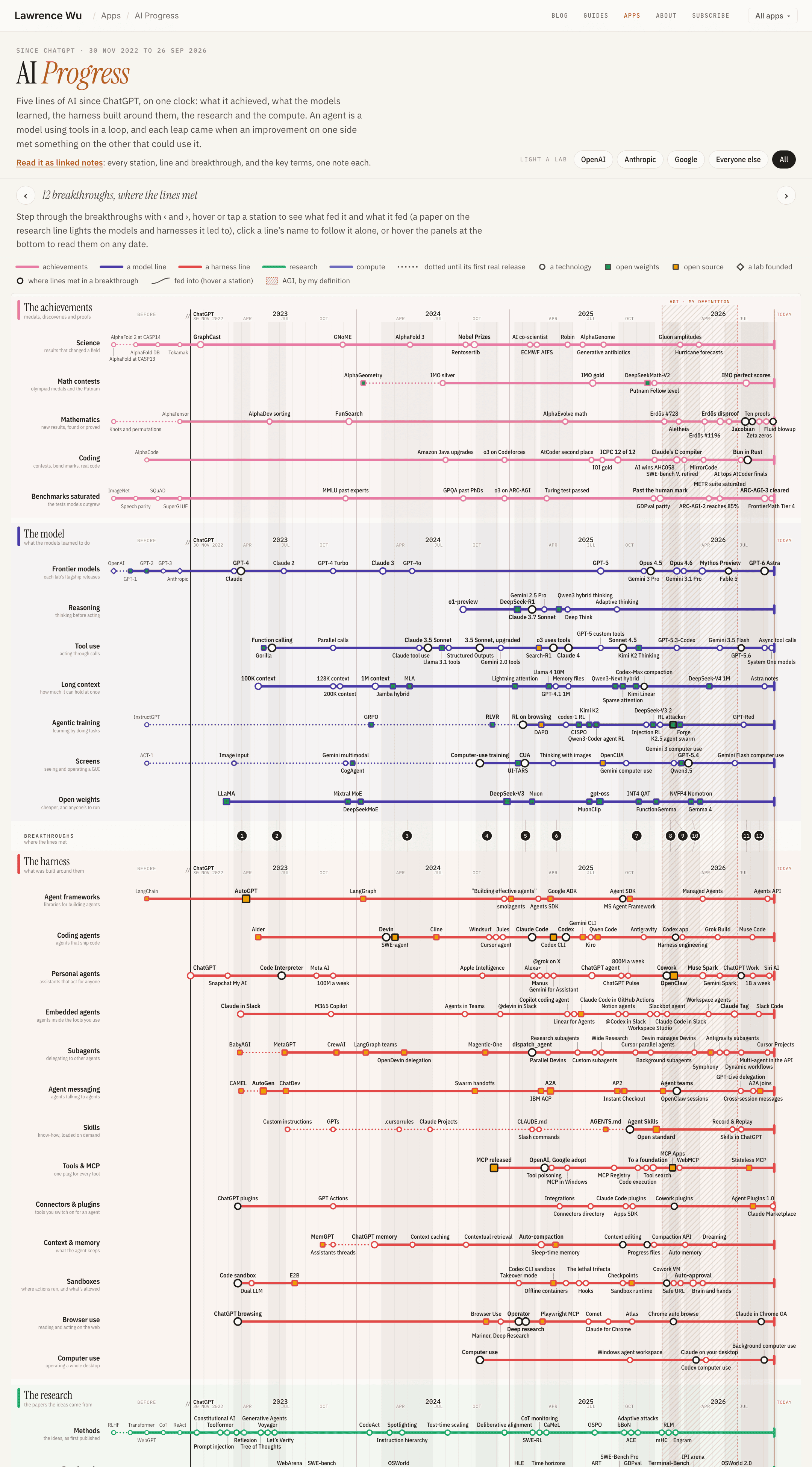
On that note, I was curious how AI has progressed the last 3 years on axes like model intelligence and agent harnesses. I was imagining two timelines with different points marking key developments. After some iteration, I wound up building a separate application where you can see the timeline of development from 2023 to Sep 2026 across:
- models
- harnesses
- achievements
- research
- compute
Claude also made a video walking through the AI progress the last few years that’s pretty good.
But both the AI progress web app and the creation of the video are yet another example of an AGI-moment for me. Creating these types of apps was not possible before. It was possible given enough time. But now, given enough tokens, one can create almost anything. Creating has become a new way of learning and exploring my interests. It’s also a new form of entertainment for me. I find it much more rewarding and exciting to learn, create and explore something than, say, watch a movie nowadays.
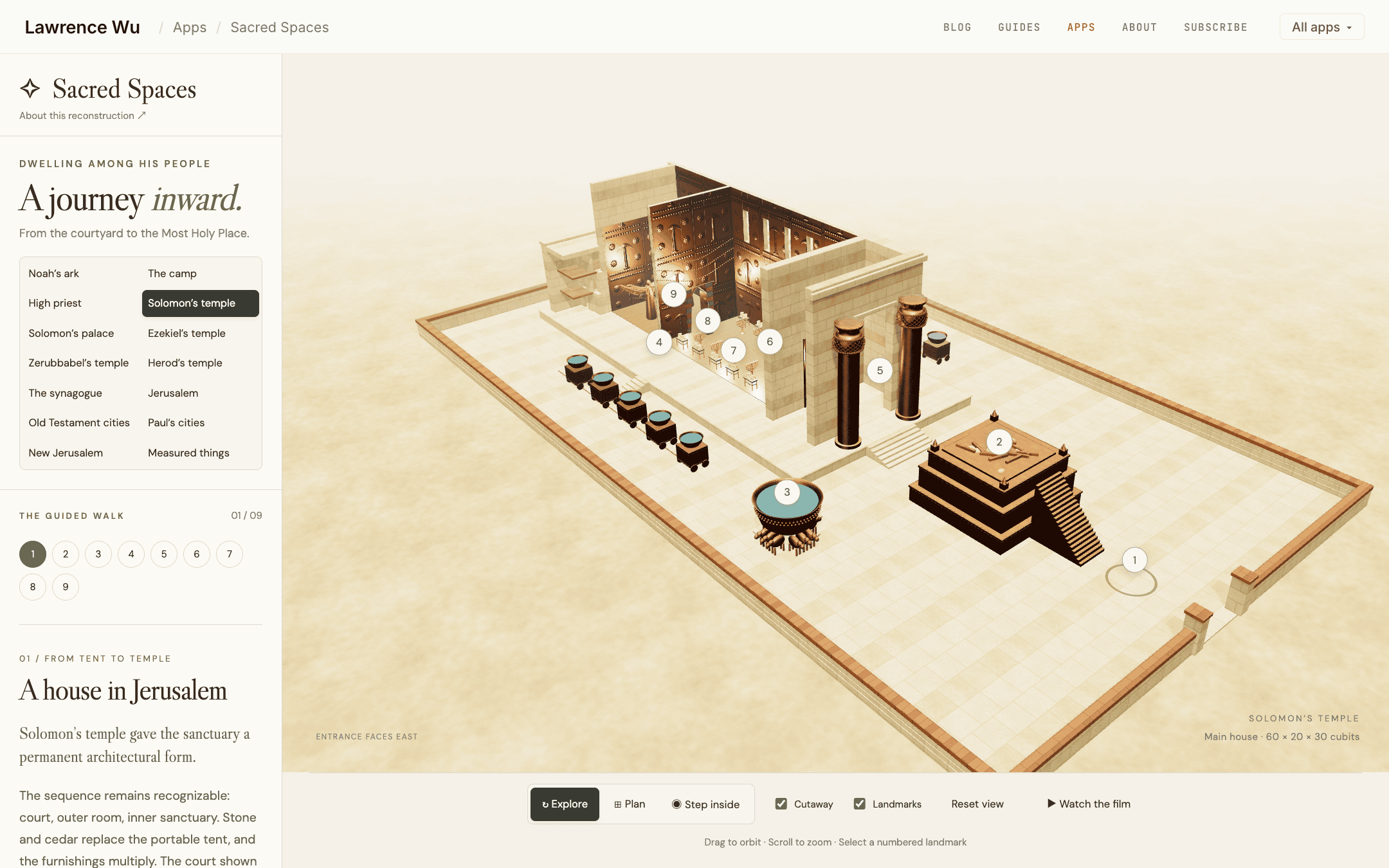
My favorite Bible is the ESV Study Bible. Two of my favorite “features” of this Bible are the maps and the illustrations. The temple illustrations are still so amazing to me like this one of Solomon’s Temple. I tried using Blender to build 3-D animations of various temples in the Bible like Solomon’s or Herod’s. I’ve never used Blender before. But Claude or any frontier model with an agent harness is able to write code to drive arbitrary software to do anything. Creating 3-D visualizations is no different. A few more prompts later I have 10+ places I can explore along with walk-through videos. Here’s Solomon’s temple:
And its walk-through video:
Even in writing this post, Claude is helping me add the temple screenshots that I used to add manually. This is the command it used to take a screenshot using a headless Chrome.
"/Applications/Google Chrome.app/Contents/MacOS/Google Chrome" \
  --headless=new \
  --use-angle=swiftshader \
  --enable-unsafe-swiftshader \
  --ignore-gpu-blocklist \
  --hide-scrollbars \
  --force-device-scale-factor=1.5 \
  --window-size=1440,900 \
  --virtual-time-budget=20000 \
  --screenshot=solomons-temple.png \
  "https://apps.lawrencewu.net/sacred-spaces/#site=temple&stop=0"
I actually didn’t know you could do that. Though it is similar to what Simon Willison has in shot-scraper. Sometimes I still like to read the model’s thinking tokens and read some of the commands it’s running to learn.
It’ll be fascinating to see how AI continues to develop. But we’re at the point where the potential applications and use-cases for AI are exploding. I’m interested to see what kind of completely new use-cases, businesses or ideas are unlocked with cheaper and faster intelligence or even other models like the one that comes after Jev.