Investing basics: why invest, stocks vs. bonds, risk
Why Invest?
Any discussion about investing needs to start with why investing is important. The main reason we invest is to grow our money over time. This growth can help us achieve our financial goals, such as retirement, education, or buying a home. This growth is important also to keep up with inflation. If you stash your cash away in savings account, you’ll lose purchasing power over time.
Something I think most people do not fully appreciate is how powerful compound interest is. This article from moneyguy.com provides a comprehensive and detailed look at the power of saving and compound interest over time.
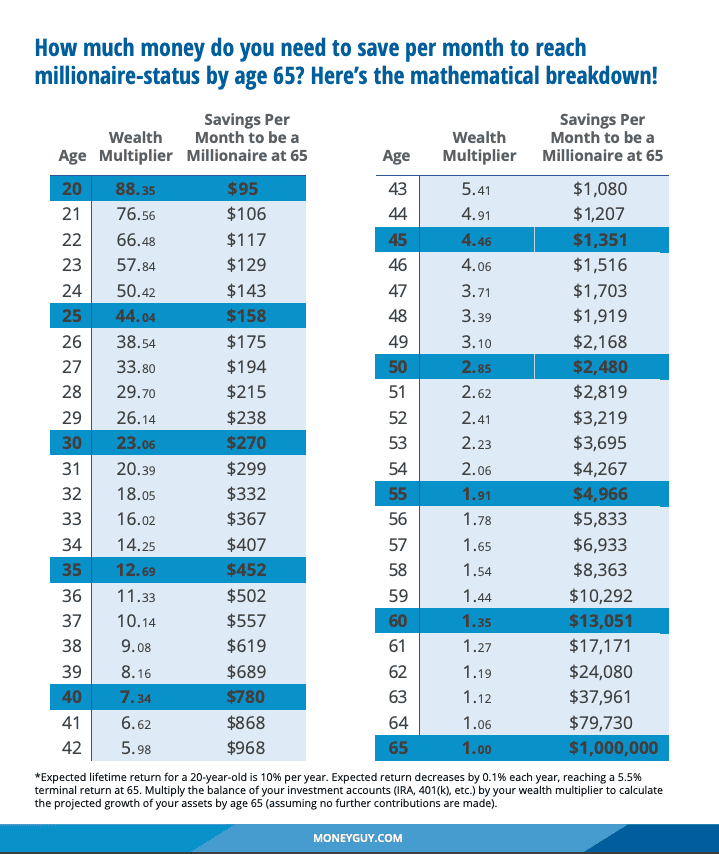
The table at the bottom provides a breakdown of how much one needs to save each month, given their current age, to reach a net worth of $1 million by 65. For instance, a 20-year-old would need to save approximately $95 per month, while a 50-year-old would need to save about $2,480 per month.
This underscores the importance of starting to save and invest as early as possible to take advantage of the power of compound interest over time. The more time you have to let your money grow, the less you have to save each month to reach your retirement goal.
Try it with your own age, goal and return: Start at 20 or 50? works out the monthly amount for every starting age, and how much of the ending balance the market supplied rather than you.
Basics
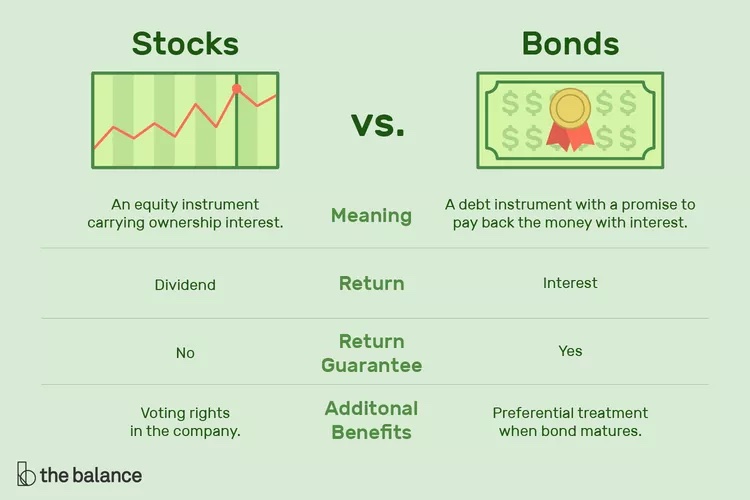
Stocks and bonds are the two primary investment types that allow individuals to participate in the financial markets, but they come with distinct characteristics and risks:
Stocks:
- Ownership: When you buy a stock, you become a partial owner of that company.
- Risk & Return: Stocks generally have a higher risk, but they also offer a higher potential return.
- Dividends: Some stocks pay dividends, which are a portion of the company’s profits distributed to shareholders.
- Voting Rights: Stockholders often have voting rights in company decisions, depending on the type of stock.
Bonds:
- Lending: When you buy a bond, you’re essentially lending money to the entity that issued the bond (like a corporation or government).
- Risk & Return: Bonds are generally considered lower risk but also provide lower potential returns compared to stocks.
- Interest: Bonds pay interest to the bondholders, usually semi-annually.
- Maturity: Bonds have a maturity date, at which point the bond issuer repays the bond’s face value to the bondholder.
Never Bear Too Much or Too Little Risk
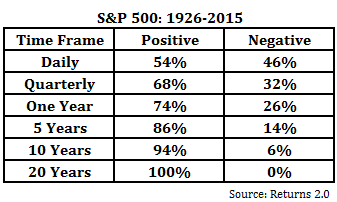
According to historical data, in the short term, stocks are perceived to be riskier than bonds. This is because stocks can exhibit substantial volatility, potentially losing up to 50% of their value in a single year. In contrast, bonds, with their fixed interest payments and principal repayment at maturity, are generally more stable and can lose around 3% in a bad year.
However, it’s crucial not to lose sight of the long-term perspective. Over time, inflation—the gradual increase in prices and consequent erosion of purchasing power—emerges as a significant risk. Strikingly, inflation makes bonds riskier than stocks over the long term. This is because the fixed interest payments of bonds do not keep pace with rising prices, effectively reducing the real return you receive from these investments.
Looking at the S&P 500 and 10-year Treasury bonds from 1928 to 2025, after inflation, bonds lost purchasing power in 37% of all 10-year periods; stocks did in 12%, about a third as often. The worst 10-year stretch for bonds (1972–1981) lost 4.9% a year after inflation, a little worse than the worst for stocks (1999–2008, −3.8% a year).
Stocks outperformed bonds in 85% of 10-year periods, and in 78 of the 79 20-year periods (the exception was 1929–1948). Over 20 years, stocks never lost money after inflation, while bonds did in a third of those periods. This demonstrates the power of equity investment for long-term wealth creation and inflation protection.
See every one of those periods, for any holding period from 1 to 30 years, in Time in the Market.
Further reading: Playing the Probabilities, which puts the 10-year figure at 89% using a different dataset.
Next: why picking stocks or paying an active manager rarely works out — The case for index funds.