How to invest: accounts and simple portfolios
This page assumes you know the why. If not, start with Investing basics and The case for index funds.
Investment Accounts
Different types of investment accounts come with various tax implications. Understanding how each works can help you make informed decisions about where to place your investments.
Standard Brokerage Account: This is a regular investment account where you use after-tax dollars to make investments. Capital gains and dividends may be subject to taxes.
Individual Retirement Accounts (IRA): IRAs are tax-advantaged retirement accounts. There are contribution limits and income restrictions. Two main types are:
- Traditional IRA: Contributions are often tax-deductible, reducing your taxable income in the year you contribute. However, withdrawals in retirement are taxed as ordinary income.
- Roth IRA: Contributions are made with after-tax dollars, so there’s no immediate tax benefit. However, in retirement, you can withdraw your money tax-free. For those with high income, a Backdoor Roth strategy can be used to contribute to a Roth IRA.
401(k) Accounts: These are employer-sponsored retirement accounts. They can be Traditional (pre-tax), Roth (after-tax), or after-tax:
- Traditional 401(k): Contributions are made pre-tax, reducing your taxable income in the year of contribution. Withdrawals in retirement are taxed as ordinary income.
- Roth 401(k): Contributions are made with after-tax dollars, but withdrawals in retirement are tax-free.
- After-tax 401(k): If your employer allows after-tax contributions, you can potentially contribute tens of thousands per year and use the Mega Backdoor Roth strategy to roll these contributions into a Roth IRA.
In general, Traditional pre-tax 401(k) contributions are often preferred to Roth contributions due to the immediate tax savings. Harry Sit makes that argument in the Case Against Roth 401ks.
1-Fund Portfolio
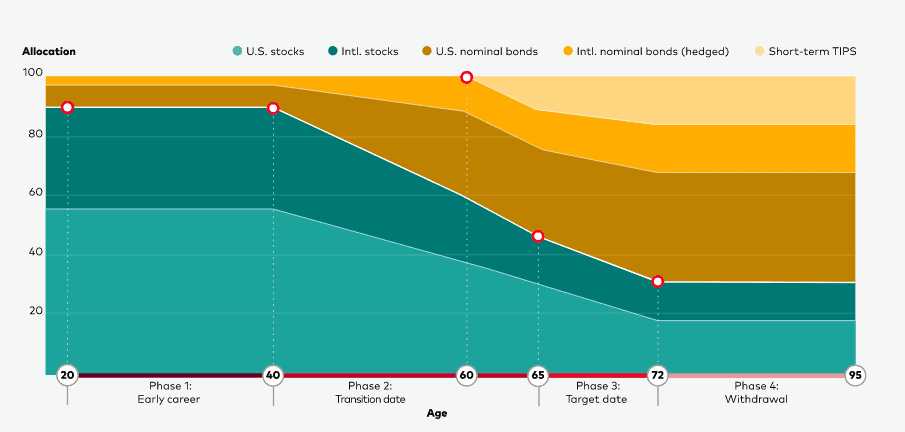
Implementing a diversified portfolio no longer requires you to buy multiple stocks and bonds or even multiple funds. There are one-fund portfolios that will do all of the heavy lifting for you. Most of the large fund providers have target-date retirement funds that are 1-fund portfolios. They each follow a glide-path that starts out more aggressive and becomes more conservative as you approach retirement. The glide path is the percentage of stocks vs. bonds. The Vanguard glide path is shown above.
Further Reading: Vanguard - TDF Glide Path
3-Fund Portfolio
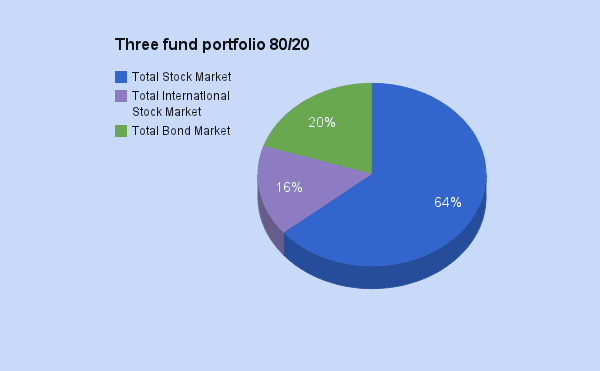
If you want a little more control over your asset allocation, you can implement a 3-fund portfolio. This is a portfolio that consists of 3 funds: a total US stock market fund, a total international stock market fund, and a total bond market fund. The percentages you allocate to each fund will depend on your risk tolerance and time horizon. For example, if you’re young and have a long time horizon, you might allocate 80% to stocks and 20% to bonds. If you’re older and have a shorter time horizon, you might allocate 60% to stocks and 40% to bonds. The 3-fund portfolio is a great way to implement a diversified portfolio with low fees.
Further Reading: Bogleheads - Three-fund Portfolio
Investing - Other Points
- The Elegance of Market Cap Weighted Index Funds: These funds allow investors to passively benefit from the price adjustments made by active managers in the market (you get to “free-ride”). As companies enter and exit the index based on their market capitalization, your portfolio adjusts automatically without requiring any action or even awareness on your part.
- Short-term Funds and the Stock Market Don’t Mix: It’s a fundamental rule of investing that any money you anticipate needing within the next five years should not be invested in the stock market. The stock market can be volatile in the short term, and there’s a risk you might need to withdraw your money at a time when your investments have lost value.
- Limit Individual Securities and Cryptocurrency Investments: If you’re drawn to investing in individual companies or cryptocurrencies, it’s recommended to limit these investments to a small portion of your total portfolio—ideally less than 5%. These types of investments can be high risk, and keeping them to a small proportion of your portfolio helps to manage that risk.
How I Invest
- 100% stocks (70% US, 30% International) using a mix of index mutual funds and ETFs
- 6 month emergency fund that’s in cash or cash equivalents