End-of-year financial checklist
The end of a calendar year is usually a good time to do some financial housekeeping. It’s better to consider these things at the end of the year because there are some things if you don’t take advantage of before the end of the year (e.g. FSAs or tax loss harvesting), you lose the opportunity to do so.
Use FSA or Other Use-It-or-Lose-It Funds
Spend any remaining funds in your Flexible Spending Account (FSA) or similar accounts, as these funds often expire at year’s end. This is a good time to make eligible purchases such as prescription glasses, dental work, or other qualifying healthcare expenses. (Deadline is December 31st)
Tax Loss Harvesting
If you have investments that have a loss, you can sell them to realize losses and use them to either offset capital gains or write off up to $3,000 of losses against income like wages. If you have more than $3,000 you can also carry forward your losses and deduct them in future tax years.
Maximize Retirement Contributions
Max out contributions to retirement accounts like 401(k)s and IRAs (Traditional or Roth) to boost retirement savings and potentially lower your taxable income. The deadline for 401k contributions is December 31st. The deadline to contribute to an IRA is the following year’s tax filing deadline (usually April 15). If your income is too high to contribute to a Roth IRA, you can always do a Backdoor Roth IRA.
Analyze your investment performance
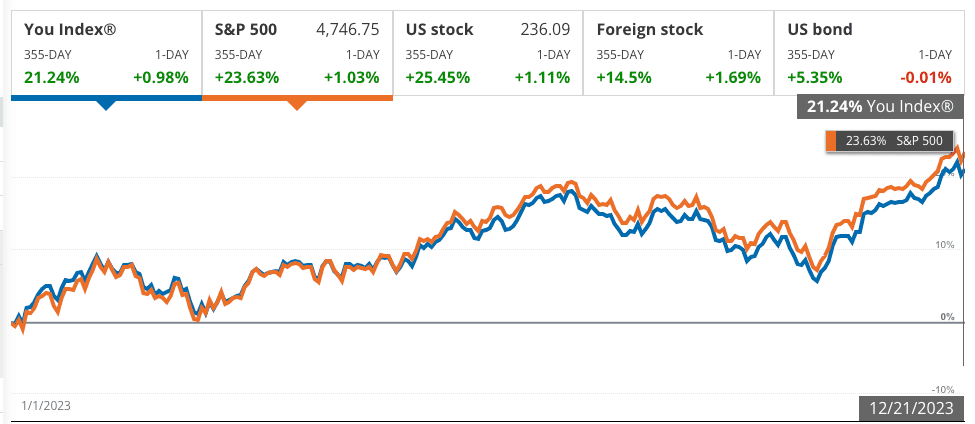
Evaluate your investments and consider rebalancing to maintain your desired asset allocation. If you aren’t invested in index funds, compare your returns against an appropriate benchmark like the S&P500 to evaluate any under- or over-performance. I use Empower’s Personal Dashboard with my investment accounts linked to calculate this for me. 2023 was a good year for buy and hold investors like myself. My underperformance to the S&P500 that year was largely explained by my allocation to international (30%). If you’re interested, you can sign up for Empower using this referral link.
Rebalance Investments
If your investments aren’t in a one-fund solution that automatically rebalances, manually adjust your portfolio to maintain your desired asset allocation. This helps in managing risk and ensuring your investment strategy stays on track.
Cancel Unused Subscriptions
Review and cancel any subscriptions or memberships you no longer use. This can lead to significant savings by eliminating recurring, often overlooked expenses.
Update your Net Worth Statement
I have a spreadsheet where I track my net worth each year. This involves calculating the total value of all your assets (such as cash, investments, property) and subtracting your liabilities (like loans, credit card debt). This exercise provides a clear picture of your financial health and helps track progress towards your financial goals. It can also reveal areas that need attention, such as high debt levels or underperforming investments, guiding your financial decisions for the upcoming year. I also use Empower to quickly find the balances of all of my asset and liability accounts.
Consider a Roth Conversion
The deadline to convert a traditional IRA to a Roth IRA is the last business day of the year. This involves paying taxes now on the converted amount, but future withdrawals from the Roth IRA would be tax free.
Donate to Charity
As the year ends, consider donating to charities. Remember, donations aren’t limited to cash; you can also donate goods or appreciated securities. You can generally deduct cash donations up to 60% of your AGI (adjusted gross income). This is limited to 30% of AGI for non-cash contributions like appreciated stock.
Consider Donation Bunching
This strategy involves consolidating multiple years’ worth of charitable donations into a single year. The idea is to exceed the standard deduction in that year, making it possible to itemize deductions and gain a larger tax benefit:
- Year 1: Donate two years’ worth of charity in one year → itemize deductions. When I’ve done this, I give next year’s amount in December of the prior year. You could also put two years of charitable contributions into a Donor Advised Fund, take the itemized deduction in that year, and then spread the donations out over two years.
- Year 2: Make no charitable donations → take the standard deduction.
- Result: More total deductions over two years than taking the standard deduction both years.
You can also prepay property tax in your bunching year — property tax is deductible in the year you pay it, not when it’s due.
Bunching works when your Year 1 itemized deductions exceed the standard deduction ($31,500 MFJ for 2025). You’re a good candidate if you have mortgage interest, regular charitable giving (8-10%+ of income), and property tax to prepay. One caveat: the One Big Beautiful Bill Act raised the SALT cap from $10,000 to $40,000 for tax years 2025-2029, so if you live in a high-tax state and your SALT alone approaches the standard deduction, you may itemize every year anyway — bunching then adds less.
For a worked example and an interactive calculator where you can plug in your own numbers, see Bunching Charitable Contributions in 2025.